Layer-by Layer — Getting Started:


Functional Prototyping with SLS 3D printing
You want to know exactly how it's going to work before you take the plunge…
It sounds like you need a functional prototype. And if you’re here, we’re guessing you aren’t sure of the best way to make one. There are many ways to prototype. There are numerous ways to prototype using different types of 3D printing. Although we cannot precisely describe what functional prototyping looks like with other methods, we can help you understand why our customers choose Selective Laser Sintering (SLS) with us. We also have some insight to share with you from our sister company, Northwest UAV (NWUAV).
We can tell you all the good stuff we know about functional prototyping with SLS — how cost-effective it can be and how quick it is — but we assume you already know. We have a pretty hefty bias. So, rather than touting how amazing we’re at prototyping (though we’re happy to do that, just say the word), we’re going to explain functional prototyping with SLS using an example and a discussion we had with an aerospace engineer at NWUAV. NWUAV designs and manufactures propulsion systems for unmanned aerial vehicles (UAVs), and one of their most recently designed engines, the NW-88 Engine, has required many functional prototyped components (just like their NW-44 engine did previously). So, we sat down with NWUAV Senior Aerospace Engineer Chris Pellegrino to understand why NWUAV continues to choose SLS for these functional prototypes.
First, let’s establish what a functional prototype is…
To ensure we’re both on the same page, let’s define what a functional prototype is. A functional prototype is a real-world example of something designed in CAD that incorporates the essential requirements and capabilities, allowing for an understanding of how the final product will function. For NWUAV, Chris explained, the functional prototype is typically the entire component, and the final product is often manufactured using the same SLS process as the prototype. It means that NWUAV’s functional prototypes undergo the same rigorous testing as the rest of the engine, both on engine test stands and in actual test flights.
But Chris clarified that a functional prototype doesn’t necessarily have to be the entire component or use the same manufacturing process used in prototyping. For example, a functional prototype in consumer products is often a rough representation of one element of a larger product, and the final components are frequently created through a more involved and expensive process once the prototypes are approved.
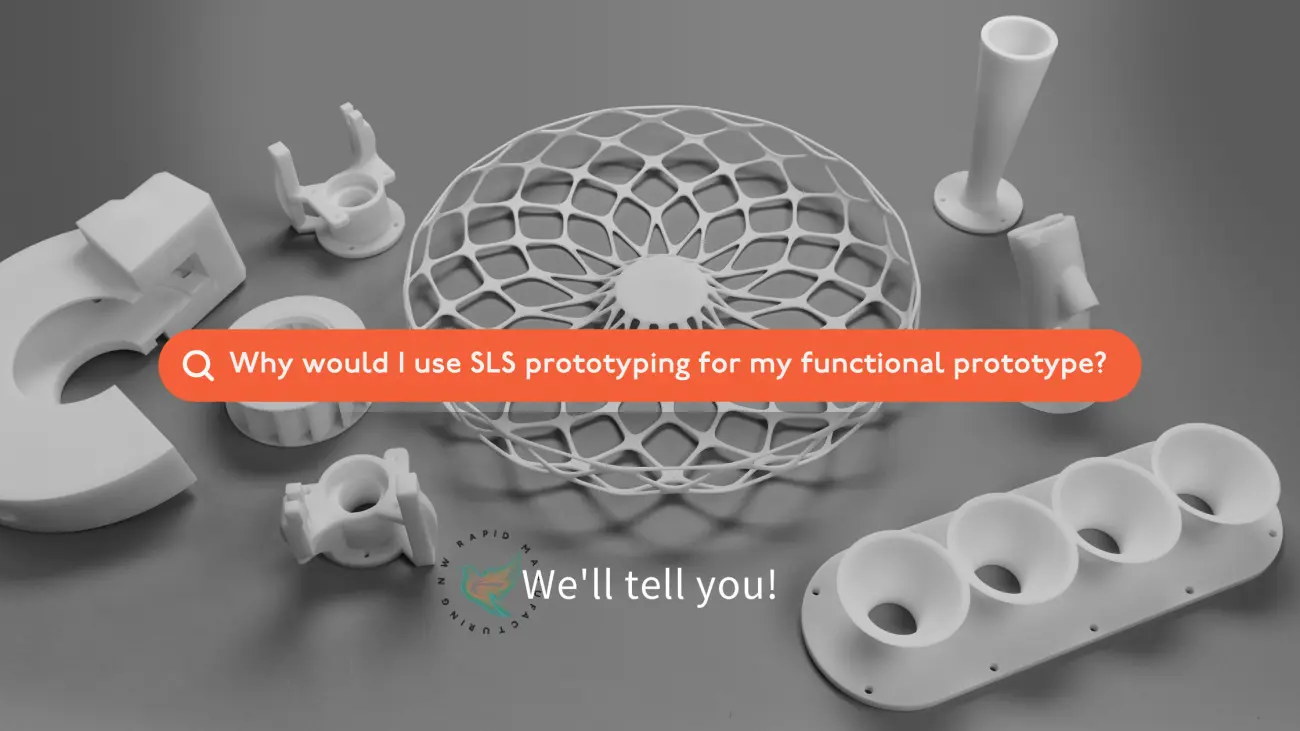
Why would I use SLS for functional prototyping?
Need an example?
Well, if you look at NWUAV’s NW-44 Engine, every part that ended up in production as an SLS part started as a functional prototype from NW Rapid Manufacturing, including the cooling shroud and puck, as pointed out in the video above. Consider this more specific example: printing a portion of an aircraft fuselage to work out engine integration details that engineers can’t develop in 3D CAD software. As Chris explained, consider designing the routing of electrical harnesses and fuel lines around the fuselage. The 3D CAD world can’t account for the reality of bending a harness around obstacles and how and where a harness is best tied down. You can’t always wait until everything is in hand to figure out these details for a variety of reasons, including the availability of the component, timeline constraints, cost, and the time it takes to send the component. In this situation, then, a great solution is a functional prototype of the fuselage for engineers to physically route electrical harnesses and fuel lines around.
Why would you choose SLS for functional prototypes?
We know this is what you want to know. Why would you choose SLS for your functional prototype? Well, we asked Chris just that, and he gave us some fantastic insight:
- Design freedom. With SLS printing, you can design pretty much whatever you want without accounting for any manufacturing limitations. A variety of constraints on part geometry that you would experience with methods like machining and injection molding don’t exist with 3D printing.
- Design changes are free. Changes not only impact the overall cost but also affect product possibilities and how much you (or the person footing the bill) are willing to explore better designs for your prototype before settling on the final manufactured part. With 3D printing, when you update your design (the whole point of prototyping), no molds or fixturing need to be modified, and no tooling paths need to be updated. You can update your design and receive a new version of your prototype with no change in cost for the latest prototype (unless, of course, you add a finishing process).
- Cost. In addition to free design changes, the design freedom that 3D printing offers can mean printing a design as a single component rather than multiple components that require assembly later. That means only one part number, one drawing, no mating interfaces to design and optimize, no mating interfaces to wear out, and no assembly time – all of which save money. And for those using production methods other than 3D printing for your final product (remember the consumer product example above), printing a prototype part is significantly cheaper (and faster) than cutting a mold.
- Speed. 3D printing is the fastest prototyping and manufacturing method available. Getting a prototype in your hand as soon as possible (to assess, test, and potentially update) is a significant advantage, especially when you have potential customers ready to see all that your product can do.
- Easy mock-ups. Thanks to its speed, 3D printing produces great mock-ups of connecting components that you don’t yet have in your hand. 3D printing can solve the problem of a missing mating component that cannot be obtained in time or doesn’t physically exist yet but is needed to complete an assembly layout. Chris offered the example of printing out a component that they’re waiting on to be cast or machined out of aluminum so they can mock something up and keep the design moving until the metal part arrives.
Okay, so how do I choose the SLS manufacturer to work with?
Though we would say look for unmatched humor and style (so basically, work with us), Chris had a few good reasons why Northwest UAV works with us at NW Rapid Manufacturing that you can apply to your search.
NW Rapid pays very close attention to the quality of the powder that they use as well as the machine settings. This attention to powder quality is crucial if you want parts that don’t come apart. NW Rapid knows the process extremely well and can inform us if the size tolerance we want is too tight or can be held tighter. They are also continually exploring other post processes that add more capabilities and quality to the finished part that helps us achieve better overall designs.
Quality, expertise, and a commitment to continued excellence in SLS manufacturing — find a company that offers all three, and you’ve found yourself a great partner for functional prototyping!
Although SLS manufacturing is just one method for manufacturing your functional prototype, it is often the fastest and most affordable way to do so. But don’t take our word for it (or Chris’ word from NWUAV). Shop around until you’re confident you’ve found the right partner for your prototyping project. Whether it’s cost, speed, quality, design freedom, or personality — note the qualities that matter most to you in your search for a prototyping partner and use those to compare your top contenders. We know you’ll find that perfect fit.
For more information, please don't hesitate to contact us at or request a quote and upload your file today!